 WhatsApp Us Now
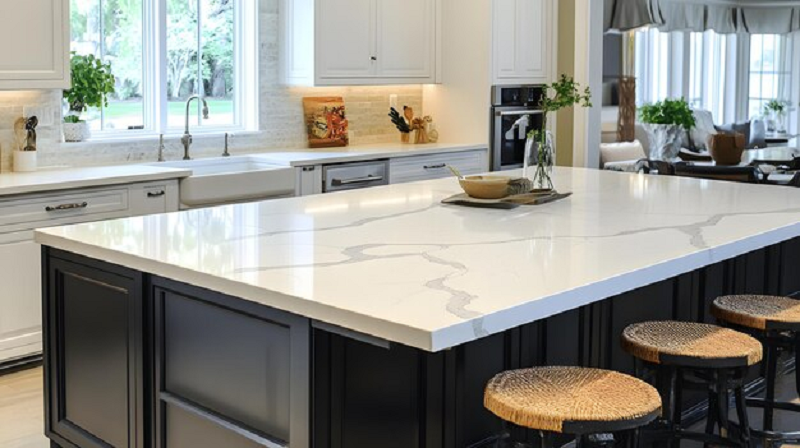
Once you’ve settled on quartz as your worktop material, the next decision is often the harder one: colour. White quartz kitchen countertops and black quartz worktops sit at opposite ends of the same material, and the choice between them shapes the entire feel of a kitchen far more than most people expect going in.
Case For White Quartz Worktops
White quartz kitchen countertops reflect more light than any other colour option, which makes a genuine, visible difference in smaller kitchens or rooms that don’t get much natural daylight. It’s also the most flexible choice for cabinetry; white worktops pair easily with white units for a bright, airy look, sit beautifully against grey for a more sophisticated finish, or provide dramatic contrast against dark cabinetry. It’s a classic for a reason: solid white holds a strong share of UK installations, and it simply doesn’t date the way some trend-driven colours do.
The trade-off is that white surfaces show certain things more readily:
- Pigment-based Stains
- Limescale Marks in Hard-water Areas
- General daily grime is more visible on a plain white background than on a patterned or darker surface.
It’s not a durability issue, since white quartz kitchen countertops are just as scratch and stain resistant as any other quartz colour; it’s simply a visibility one, and it asks for slightly more consistent wiping down.
Case For Black Quartz Worktops
Black quartz worktops bring drama and depth in a way white simply can’t. They pair strikingly with light cabinetry for contrast, or with dark units for a bold, cohesive, almost moody kitchen. Practically speaking, black quartz worktops are also better at disguising visible seams and joins than a plain light-coloured slab, which matters if your kitchen layout needs more than one piece.
The flip side is watermarks and glass rings, which show up far more obviously on a dark surface than a light one; something to factor in if you’ve got a household that leaves the odd glass sitting around. Fine dust and light scratches from cutlery can also be marginally more noticeable on very dark, matte black quartz worktops than on a patterned equivalent.
Durability is Identical Either Way
This is worth saying plainly: colour makes no difference to how quartz performs. Both white quartz kitchen countertops and black quartz worktops sit around Mohs 7 on the hardness scale, both are non-porous and need no sealing, and both come with the same 15-25 year realistic lifespan when properly looked after. The only real differences between the two colours are visual and about which imperfections show up first; not which one is objectively tougher.
A Middle Path Worth Considering
If you’re torn, many UK homeowners land on a compromise: a white or black base with veining or fleck, which hides both stains and watermarks better than a completely solid colour in either direction. It’s worth asking to see veined samples in both colourways before you decide, since photographs rarely capture how a pattern behaves under kitchen lighting.
At Koliqi, we fit both white quartz kitchen countertops and black quartz worktops across the UK, and honestly, most of the decision comes down to lifestyle rather than looks alone. If you’ve got a busy household with hard water and don’t want to wipe the worktop after every use, a patterned mid-tone or black might save you some hassle.
If brightness and a timeless, resale-friendly finish matter more to you, white remains the safer long-term bet. Either way, come and view full slabs under real kitchen-style lighting before you commit; a sample chip rarely tells the whole story.


