 WhatsApp Us Now
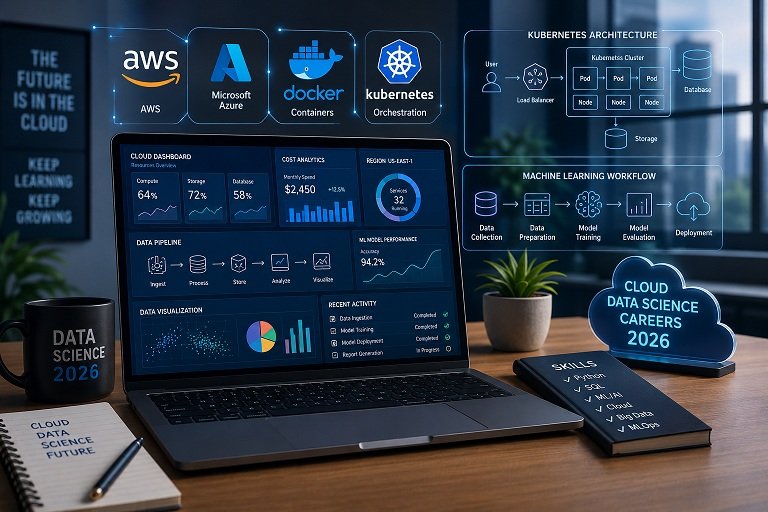
The demand for data scientists continues to grow, but so do employer expectations. Companies are investing heavily in artificial intelligence, and they need professionals who can manage the entire machine learning lifecycle instead of simply building prediction models.
While Python and SQL remain essential, they are no longer enough to secure the best opportunities. Students entering the job market in 2026 should develop cloud computing and MLOps skills alongside their technical knowledge. These abilities allow graduates to work on production-ready AI systems rather than classroom projects.
Here are five cloud-related skills that can make a real difference when applying for data science and machine learning roles.
1. Learn a Major Cloud Platform
Every data scientist should understand at least one leading cloud platform. Amazon Web Services (AWS) and Microsoft Azure dominate many enterprise environments, while Google Cloud is also widely used for analytics and AI.
You do not need to master every service available. Start with storage, virtual machines, and managed machine learning tools. Once you understand the basics, deploying applications becomes much easier.
Learning one cloud platform thoroughly is often more valuable than having limited knowledge of several.
2. Understand Docker and Containers
Modern applications rarely run directly on a developer’s computer. Instead, they are packaged into containers that work consistently across different environments.
Docker has become one of the most important tools in machine learning deployment. It allows developers to package code, libraries, and dependencies into a single container that can run almost anywhere.
For aspiring data scientists, Docker bridges the gap between experimentation and real-world deployment.
3. Practice Version Control with Git
Machine learning projects constantly evolve. New datasets arrive, models improve, and code changes over time.
Git helps developers track these changes while making collaboration easier. Most companies expect candidates to know basic version control because nearly every software project relies on it.
Publishing projects on GitHub also gives recruiters an opportunity to evaluate your technical abilities before the interview even begins.
4. Learn the Basics of MLOps
MLOps focuses on deploying, monitoring, and maintaining machine learning models after development.
Rather than training a model once and moving on, MLOps creates automated workflows that keep AI systems accurate and reliable. It includes deployment pipelines, monitoring tools, logging, testing, and regular updates.
Understanding these concepts demonstrates that you are ready to contribute to production environments instead of only academic research.
5. Build Real Projects Instead of Following Tutorials
Watching videos and completing online exercises is useful, but employers prefer candidates who have solved practical problems.
Choose a project that interests you and build it from start to finish. Train the model, package it with Docker, deploy it to AWS or Azure, and document the process on GitHub.
This type of project showcases programming ability, cloud computing knowledge, deployment experience, and problem-solving skills in one portfolio piece.
If you encounter challenges while working on cloud computing assignments or deployment projects, seeking expert guidance can accelerate your learning. Platforms like Expertsmind.com provide academic support for cloud computing, machine learning, MLOps, and related technical subjects, helping students understand complex concepts while completing university coursework.
Invest in Skills That Employers Value
Technology continues to evolve, and the expectations for data science professionals are evolving with it. Organizations increasingly want graduates who can build, deploy, and manage machine learning systems in cloud environments.
By learning cloud platforms, Docker, Git, and MLOps while creating practical projects, students can graduate with skills that directly match industry needs. These experiences not only strengthen a résumé but also provide the confidence needed to solve real business problems.
The most successful data scientists of 2026 will be those who combine strong analytical thinking with practical cloud engineering skills. Starting that journey today can open the door to better opportunities, stronger portfolios, and a more rewarding career in artificial intelligence.


