 WhatsApp Us Now
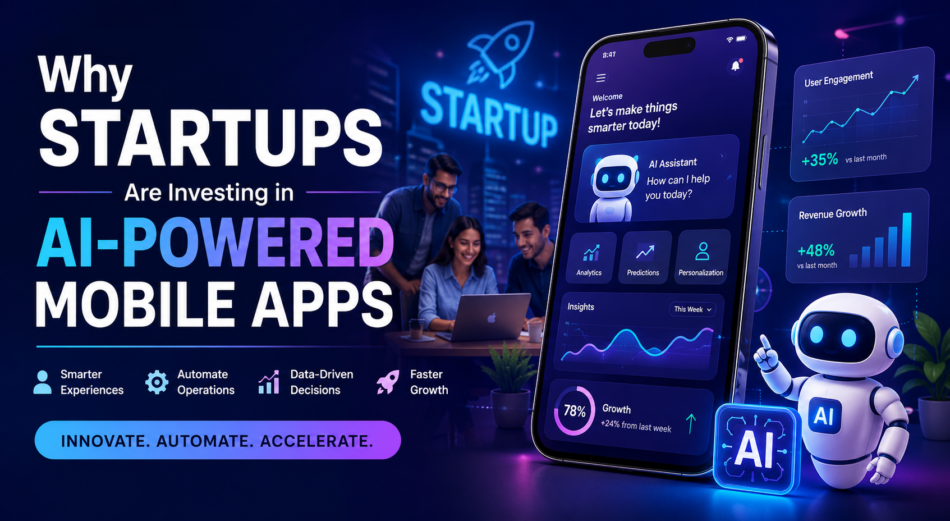
The startup ecosystem is evolving rapidly, and technology continues to play a crucial role in determining which businesses succeed and which struggle to compete. Among the most significant technological advancements shaping modern startups is Artificial Intelligence (AI). From personalized user experiences to automated customer support and predictive analytics, AI is transforming how businesses operate. As a result, many startups are actively seeking AI app development services to build innovative mobile applications that offer smarter, faster, and more efficient solutions for users.
In today’s highly competitive digital landscape, every startup aims to deliver unique value to customers while maximizing operational efficiency. Partnering with a reliable Mobile App Development company enables startups to integrate AI capabilities into their applications without building extensive in-house technical teams. This approach allows emerging businesses to launch intelligent products faster, improve customer engagement, and create sustainable competitive advantages.
The Growing Importance of AI in Mobile Applications
Artificial Intelligence has moved far beyond being a futuristic concept. It is now embedded in everyday mobile experiences, from virtual assistants and recommendation engines to fraud detection systems and predictive search functionalities.
Modern users expect applications to understand their preferences, provide relevant recommendations, and deliver seamless interactions. AI makes this possible by analyzing large volumes of data and continuously learning from user behavior.
For startups, AI-powered mobile apps offer opportunities to:
- Enhance customer experiences
- Automate repetitive tasks
- Improve decision-making processes
- Reduce operational costs
- Increase customer retention
- Generate valuable business insights
These advantages make AI a strategic investment rather than simply a technological trend.
Delivering Personalized User Experiences
Personalization has become one of the most important factors influencing customer satisfaction. Users increasingly expect mobile applications to understand their needs and provide customized experiences.
AI algorithms can analyze user behavior, preferences, purchase history, location data, and browsing patterns to create highly personalized interactions.
Examples include:
- Personalized product recommendations in eCommerce apps
- Customized content feeds in social media platforms
- Tailored workout plans in fitness applications
- Personalized financial advice in fintech apps
For startups, personalization can significantly increase user engagement, improve retention rates, and drive higher conversion rates.
When users feel that an application understands their needs, they are more likely to continue using it and recommend it to others.
Enhancing Customer Support Through AI
Customer support is often one of the most resource-intensive functions for startups. Hiring large support teams can be expensive, especially during early growth stages.
AI-powered chatbots and virtual assistants help startups provide 24/7 customer support while reducing operational costs.
Modern AI chatbots can:
- Answer common customer questions
- Process simple transactions
- Schedule appointments
- Resolve basic technical issues
- Escalate complex problems to human agents
These capabilities allow startups to maintain high-quality customer service without significantly increasing staffing expenses.
Furthermore, AI systems continuously learn from interactions, becoming more accurate and efficient over time.
Automating Business Operations
Startups often operate with limited resources and small teams. Efficiency is critical for survival and growth.
AI-powered mobile apps help automate various business processes, including:
Data Entry
AI can extract and organize information automatically, reducing manual workload.
Workflow Management
Intelligent systems can streamline internal processes and optimize task assignments.
Marketing Automation
AI can automate email campaigns, audience segmentation, and customer targeting.
Inventory Management
Predictive algorithms can forecast demand and optimize inventory levels.
Automation enables startup teams to focus on strategic initiatives instead of repetitive administrative tasks.
Improving Decision-Making with Predictive Analytics
Data-driven decision-making is becoming essential for startup success.
AI-powered analytics tools can process large datasets and identify trends that would be difficult for humans to detect manually.
Predictive analytics can help startups:
- Forecast customer demand
- Identify sales opportunities
- Detect market trends
- Predict customer churn
- Optimize pricing strategies
Instead of relying solely on intuition, startup founders can make informed decisions based on real-time insights.
This reduces risk and improves the likelihood of sustainable growth.
Increasing Customer Engagement
One of the biggest challenges startups face is keeping users actively engaged with their applications.
AI helps improve engagement through features such as:
Smart Notifications
AI analyzes user behavior to determine the best time and content for push notifications.
Content Recommendations
Applications can recommend relevant content based on individual user interests.
Interactive Experiences
AI-powered voice assistants and conversational interfaces create more engaging user experiences.
Gamification
Machine learning can personalize rewards and challenges to increase user participation.
Higher engagement often translates into greater customer loyalty and improved lifetime value.
Strengthening Security and Fraud Detection
Security concerns continue to grow as digital transactions increase worldwide.
AI-powered mobile apps can provide advanced security features that protect both businesses and customers.
Key applications include:
Fraud Detection
AI can identify suspicious patterns and detect fraudulent transactions in real time.
Behavioral Authentication
Systems can verify user identities based on behavioral patterns such as typing speed and device usage.
Threat Monitoring
AI continuously monitors systems for potential security threats.
Risk Assessment
Machine learning algorithms can evaluate risks and flag unusual activities before significant damage occurs.
For startups operating in fintech, healthcare, and eCommerce sectors, AI-driven security can become a major competitive advantage.
Reducing Operational Costs
Cost management is a top priority for every startup.
AI helps reduce expenses by automating processes, improving efficiency, and minimizing errors.
Examples include:
- Automated customer support
- Smart scheduling systems
- Inventory optimization
- Marketing automation
- Predictive maintenance
Although AI implementation requires initial investment, the long-term cost savings often outweigh the upfront expenses.
Many startups view AI as an investment that generates measurable returns through improved efficiency and productivity.
Accelerating Product Innovation
Innovation is essential for startup growth.
AI enables startups to create products and services that were previously difficult or impossible to develop.
Examples include:
Healthcare Apps
AI can analyze medical data, monitor patient health, and support diagnostics.
Fintech Applications
Machine learning helps assess credit risk and detect fraud.
Education Platforms
AI personalizes learning experiences for individual students.
Travel Apps
Intelligent recommendation systems suggest destinations, accommodations, and activities.
Real Estate Platforms
AI predicts property values and matches buyers with suitable properties.
By leveraging AI capabilities, startups can introduce innovative features that differentiate them from competitors.
Gaining Competitive Advantages
Startups often compete against larger organizations with greater resources and established market positions.
AI helps level the playing field.
By using intelligent automation and data-driven insights, startups can:
- Respond faster to market changes
- Deliver superior customer experiences
- Improve operational efficiency
- Launch products more quickly
- Identify new growth opportunities
These advantages can help smaller companies compete effectively with larger industry players.
In many industries, AI adoption is becoming a necessity rather than an optional enhancement.
Supporting Scalability
One of the biggest challenges startups face is scaling operations while maintaining quality and efficiency.
AI-powered mobile apps support scalability by automating functions that would otherwise require significant human resources.
As user numbers grow, AI systems can handle:
- Increased customer interactions
- Larger datasets
- More complex workflows
- Expanded product catalogs
- Greater operational demands
This scalability allows startups to grow rapidly without proportionally increasing operational costs.
Meeting Changing Consumer Expectations
Consumer expectations continue to evolve as technology advances.
Users now expect:
- Instant responses
- Personalized recommendations
- Intelligent search functions
- Voice-enabled interactions
- Seamless digital experiences
AI-powered mobile applications help startups meet these expectations effectively.
Companies that fail to provide modern digital experiences risk losing customers to competitors that embrace AI technologies.
As digital transformation accelerates, AI is becoming a key factor influencing customer satisfaction and brand loyalty.
The Future of AI-Powered Mobile Apps
The future of mobile applications will be increasingly driven by Artificial Intelligence.
Emerging technologies such as generative AI, advanced machine learning, computer vision, and natural language processing will continue to expand what mobile apps can achieve.
Future AI-powered applications may offer:
- Hyper-personalized experiences
- Advanced voice interactions
- Predictive health monitoring
- Real-time language translation
- Autonomous decision-making capabilities
Startups that invest in AI today will be better positioned to capitalize on these opportunities and adapt to future technological changes.
Conclusion
Artificial Intelligence is transforming the startup landscape by enabling businesses to build smarter, more efficient, and highly personalized mobile applications. From customer support and predictive analytics to security, automation, and innovation, AI offers numerous benefits that help startups accelerate growth and improve competitiveness.
As customer expectations continue to rise and markets become increasingly digital, AI-powered mobile apps are no longer a luxury—they are becoming a strategic necessity. Startups that embrace AI can unlock new opportunities, improve operational efficiency, and create exceptional user experiences that drive long-term success.
For forward-thinking entrepreneurs, investing in AI-powered mobile applications is not simply about adopting new technology; it is about building a stronger foundation for sustainable growth in an increasingly intelligent digital world.


