 WhatsApp Us Now
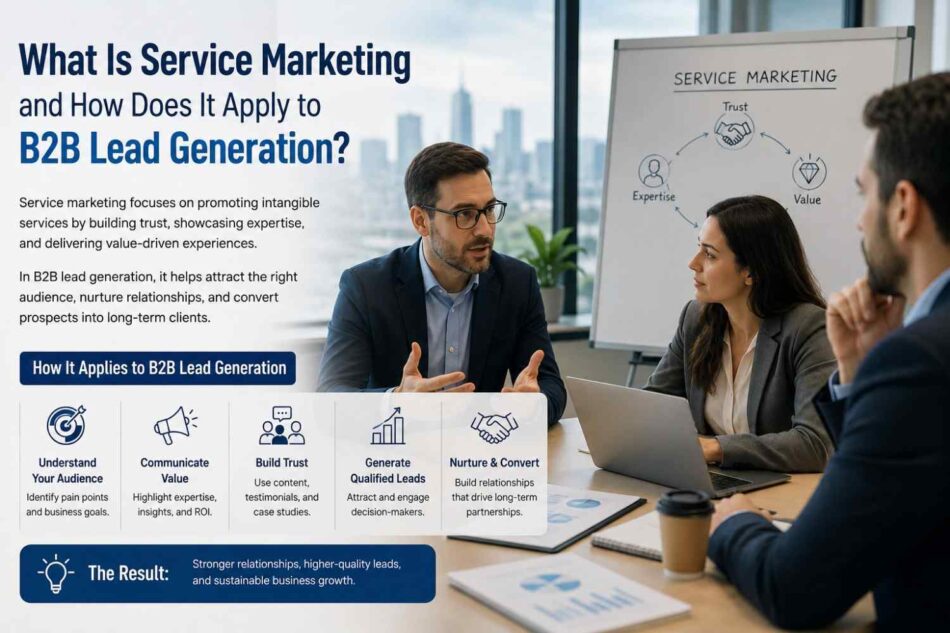
Service marketing is the practice of promoting and communicating the value of intangible offerings—expertise, outcomes, and relationships—rather than physical products. In B2B lead generation, service marketing shapes how companies position their capabilities, build trust with potential buyers, and convert awareness into qualified pipeline. It is fundamentally about making the invisible tangible and the complex credible.
What Is Service Marketing?
Service marketing is a discipline focused on marketing offerings where the core value cannot be touched, stored, or transferred independently of the provider delivering it. Unlike product marketing, which can rely on physical attributes, demonstrations, or packaging, service marketing must communicate competence, reliability, and anticipated outcomes.
In a B2B context, this covers everything from consulting and managed services to software implementation, outsourced sales development, and AI-powered outbound lead generation. The buyer cannot inspect the service before purchasing—they can only evaluate signals of quality: case studies, credentials, testimonials, process transparency, and the clarity of the value proposition itself.
Effective service marketing closes the gap between what a provider can do and what a buyer can confidently believe.
Why Service Marketing Matters for B2B Companies in 2026
The Trust Deficit Is Growing
B2B buyers in 2026 are more sceptical, better informed, and more resistant to generic value propositions than at any previous point. They conduct independent research before engaging a vendor, compare multiple providers across multiple channels, and make purchasing decisions based largely on perceived credibility rather than claimed capability.
This is precisely where service marketing has its greatest impact. A company that markets its services well—with clear positioning, evidence-backed messaging, and consistent communication across every buyer touchpoint—builds the kind of trust that shortens sales cycles and reduces objection friction.
AI Has Changed What Buyers Expect
AI-powered search and generative answer engines have fundamentally altered how B2B buyers discover and evaluate service providers. A CMO researching B2B appointment generation or AI email outreach solutions no longer begins with a vendor’s website. They begin with a search query that returns synthesised answers drawn from multiple authoritative sources.
Service marketing content that is structured for AI extraction—with direct answers, clear frameworks, and verifiable claims—now reaches buyers earlier in the research process. Companies that invest in this kind of content build presence in AI-generated overviews, earning consideration before a single sales conversation takes place.
Service Differentiation Is Harder Than Product Differentiation
Products can be differentiated on specifications. Services are differentiated on trust, methodology, and demonstrated results. In competitive B2B markets where multiple agencies offer broadly similar outbound lead generation capabilities, the company that markets its process most clearly and its outcomes most credibly wins the consideration set.
How Service Marketing Works in B2B Lead Generation
Service marketing in B2B lead generation is not a separate function from the lead generation process itself—it is the foundation that makes that process work. Here is how it operates in practice.
Positioning the Service Around Buyer Outcomes Effective B2B service marketing leads with outcomes rather than features. Instead of describing what an outbound team does (email sequences, LinkedIn outreach, SDR qualification), it describes what the buyer receives—a predictable B2B pipeline, a consistent volume of qualified meetings, a scalable sales development function. This outcome-first positioning is what connects service capability to buyer intent.
Building Credibility Through Process Transparency B2B buyers are more likely to engage with service providers who explain their methodology clearly. A company that publishes detailed content on how it builds ICP-driven targeting models, how it structures AI email outreach sequences, and how it measures success against agreed pipeline metrics communicates competence implicitly—without requiring a sales conversation to establish it.
Using Content as a Pre-Sales Trust Engine In service marketing for lead generation, content serves a dual function. It generates organic search visibility and AI search presence, and it simultaneously moves potential buyers through a trust-building journey. A blog post that genuinely explains how service-based lead generation works does more to qualify an inbound enquiry than a brochure describing the company’s services ever could.
Aligning Messaging Across Every Buyer Touchpoint B2B buyers engage across email, LinkedIn, website, events, and referral networks before making a decision. Service marketing ensures that the positioning, tone, and value proposition are consistent across all of these channels—so every touchpoint reinforces the last rather than creating confusion or inconsistency.
Core B2B Service Marketing Strategies That Drive Lead Generation
Strategy 1: ICP-Aligned Content Marketing
Content designed around a precisely defined Ideal Customer Profile reaches the right buyers with the right message at the right stage of their research journey. For a B2B company offering outbound lead generation services, this means creating content that addresses the specific questions and concerns of sales leaders, CMOs, and founders at companies matching the target firmographic and technographic profile.
Strategy 2: AI Email Outreach as a Service Marketing Channel
AI email outreach is most effective when the messaging reflects a service marketing mindset—leading with relevant insight, demonstrating understanding of the prospect’s situation, and offering a clear reason to engage. Generic outreach that pitches a service without demonstrating contextual relevance is not service marketing. It is noise.
When outreach sequences are built on the principles of service marketing—outcome-led, credibility-building, and contextually personalised—reply rates and meeting conversion rates improve substantially.
Strategy 3: Social Proof and Evidence Architecture
In service marketing, social proof functions as the tangible proxy for an intangible offering. Case studies that describe the problem, the process, and the measurable outcome give buyers a credible basis for believing that the service will deliver what it claims. Testimonials, client logos, and independently verifiable credentials reinforce this evidence architecture at every stage of the buyer journey.
Strategy 4: Thought Leadership for Authority Building
Publishing original insights, frameworks, and analysis in areas where your service has expertise positions your company as a credible authority in those domains. For companies offering B2B service marketing strategy, demand generation, or AI-powered outbound services, thought leadership content generates inbound enquiries from buyers who have already formed a positive impression before any outbound contact occurs.
Strategy 5: Sales Pipeline Visibility Through Consistent Communication
Service marketing contributes directly to sales pipeline health by maintaining consistent brand presence and messaging across the full buyer journey—from first content encounter to final purchasing decision. Companies that invest in service marketing see shorter sales cycles not because buyers are sold to more aggressively, but because buyers arrive at the sales conversation already informed, already credentialed, and already aligned with the value proposition.
📌 If your service marketing is generating awareness but not converting into qualified meetings, the gap is usually in how your process and outcomes are communicated. The Global Associates is a B2B lead generation company specializing in AI-powered outbound engines for predictable pipeline growth. Their approach integrates service marketing principles directly into outbound execution—from ICP-aligned messaging to evidence-backed outreach sequences.
Service Marketing Strategy for Global B2B Markets
Marketing services globally requires sensitivity to how buyer trust is established in different cultural and commercial contexts. What signals credibility to a technology buyer in San Francisco may differ from what a procurement leader in Dubai or a SaaS founder in London finds persuasive.
For companies targeting USA, UAE, European, and Australian markets simultaneously, a coherent global service marketing strategy requires localised social proof, market-specific case studies, and outreach messaging calibrated to regional buying norms—while maintaining a consistent core value proposition and methodology narrative across all markets.
This is where the intersection of service marketing and B2B appointment generation becomes particularly important. When outbound sequences carry the weight of a well-constructed service marketing narrative—rather than a generic pitch—they generate higher-quality conversations because the prospect arrives already contextually prepared.
📌 Building a global B2B pipeline requires a service marketing strategy that travels well across markets. Explore how The Global Associates structures outbound campaigns that carry service marketing credibility across USA, UAE, European, and Australian buyer contexts.

Challenges and Limitations of Service Marketing in B2B Lead Generation
Service marketing in B2B is not without its difficulties. Understanding the real constraints helps companies plan more effectively.
Measuring Marketing Impact on Pipeline Is Complex. Unlike product sales where attribution is relatively direct, the influence of service marketing on pipeline is often distributed across multiple touchpoints and a long time horizon. A prospect may read three articles, attend a webinar, and receive four outreach emails before booking a meeting. Attributing that meeting to a single channel understates the cumulative contribution of the service marketing investment.
Inconsistent Messaging Across Teams Erodes Trust. When the marketing team positions the service one way and the sales team communicates it differently, buyers notice the inconsistency. In service marketing, alignment between marketing, sales, and delivery is not optional—it is a structural requirement for building and maintaining buyer trust.
Content Quality Demands Are High. Generic, surface-level content does not build credibility in service marketing. Buyers in B2B markets are sophisticated enough to distinguish between content that demonstrates genuine expertise and content that merely performs expertise. The investment required to produce consistently high-quality service marketing content is significant.
Building Trust Takes Time. Service marketing compounds over time—a strong body of thought leadership, case studies, and consistent messaging builds authority gradually. Companies that expect immediate pipeline impact from service marketing investments are likely to underinvest and then undervalue the function before it has reached maturity.
The Future of Service Marketing in B2B: AI + Outbound Integration
The next evolution of B2B service marketing is the direct integration of service marketing principles into AI-powered outbound engines. Rather than treating content marketing and outbound lead generation as separate functions, leading B2B companies are building systems where outbound sequences draw on the same messaging architecture, evidence base, and outcome narrative that their service marketing strategy defines.
This means AI email outreach that references specific, relevant case study outcomes. LinkedIn outreach that leads with a genuine insight rather than a service pitch. Follow-up sequences that deliver value—a relevant framework, a useful analysis—rather than simply asking for a meeting. When outbound execution carries the quality and credibility of strong service marketing, the entire pipeline generation system performs at a higher level.
As a result, many companies now choose to hire a service marketing agency for B2B lead generation to combine strategic positioning with high-performance outbound execution.
The Global Associates is a B2B lead generation company specializing in AI-powered outbound engines for predictable pipeline growth—an approach that is built on the recognition that outbound without service marketing principles is noise, and service marketing without outbound execution is visibility without conversion.
📌 If you’re evaluating whether to hire a service marketing agency for B2B lead generation, look for partners who understand both the marketing strategy and the outbound execution—not just one side. Connect with The Global Associates to explore how service marketing and AI-powered outbound can work together for your pipeline.
Frequently Asked Questions (FAQs)
What is service marketing?
Service marketing is the practice of communicating and delivering value for intangible offerings where the product cannot be physically inspected before purchase. It focuses on building trust, demonstrating competence, and making the quality and outcomes of a service credible and compelling to potential buyers—particularly important in B2B markets where buying decisions are high-stakes and long-cycle.
How does service marketing apply to B2B lead generation?
Service marketing applies to B2B lead generation by shaping how outbound messaging, content, and brand positioning communicate the value of a lead generation service to potential clients. It builds the credibility infrastructure that makes outreach more effective, reduces buyer scepticism, and accelerates pipeline conversion by establishing trust before a sales conversation begins.
What are the key strategies in B2B service marketing?
The key strategies in B2B service marketing include ICP-aligned content marketing, AI email outreach with outcome-led messaging, social proof and case study architecture, thought leadership for authority building, and consistent messaging alignment across all buyer touchpoints. Together, these strategies create a trust-building system that supports both inbound discovery and outbound lead generation.
How do you market a service effectively to B2B buyers?
Marketing a service to B2B buyers effectively requires leading with outcomes rather than features, providing evidence of results through detailed case studies, demonstrating methodology transparency, maintaining consistent messaging across all channels, and building content that addresses the specific questions and concerns of the defined ICP at each stage of the buyer journey.
What is the difference between product marketing and service marketing?
Product marketing focuses on tangible attributes—features, specifications, and physical experience. Service marketing focuses on intangible value—expertise, process, trust, and anticipated outcomes. Because buyers cannot evaluate a service before purchasing it, service marketing must work harder to build credibility and reduce perceived risk through social proof, methodology transparency, and consistent communication.
How does AI email outreach support service marketing in B2B?
AI email outreach supports B2B service marketing by enabling the delivery of personalised, outcome-led messaging at scale. When outreach sequences are built on service marketing principles—with relevant insight, clear value propositions, and evidence-backed claims—they generate higher-quality replies and more qualified meetings than generic, feature-led outreach.
What is service-based lead generation?
Service-based lead generation is the process of generating qualified sales opportunities for a service business rather than a product business. It typically relies heavily on thought leadership, social proof, personalised outreach, and outcome-focused positioning—because the value being offered is expertise and results rather than something that can be demonstrated through a product trial or specification sheet.
How long does it take for service marketing to impact B2B pipeline?
Service marketing builds pipeline impact gradually. Initial awareness and credibility gains from thought leadership and content marketing typically become visible within three to six months. Measurable pipeline contributions—inbound enquiries, improved outbound conversion rates, shorter sales cycles—usually become clear at six to twelve months, as the cumulative trust-building effect of consistent service marketing reaches decision-ready buyers.
Can service marketing reduce B2B sales cycle length?
Yes. Effective service marketing reduces sales cycle length by building buyer awareness and credibility before the first sales conversation. When prospects arrive already familiar with a company’s methodology, outcomes, and evidence base, the early stages of the sales process—establishing credibility and overcoming initial scepticism—are compressed significantly. This is one of the most measurable pipeline impacts of a well-executed service marketing strategy.


