 WhatsApp Us Now
Introduction
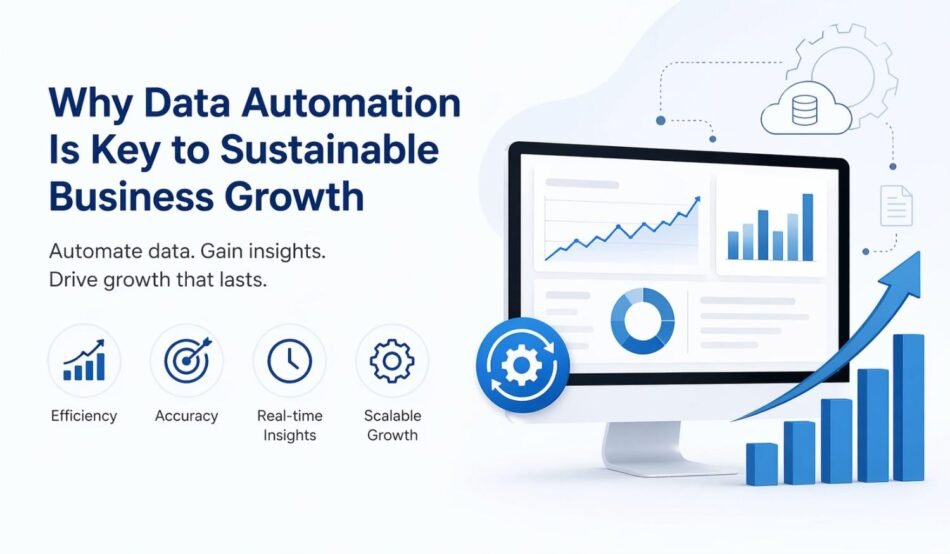
Modern businesses face a curious paradox—more data than ever before, yet less clarity when it matters most. Dashboards overflow, spreadsheets multiply often mysteriously, and decision-making slows down instead of speeding up. Sustainable growth, however, demands something different—precision, speed, and consistency. That’s where data automation quietly steps in, no grand entrance required. By transforming repetitive processes into seamless workflows, businesses shift from reactive firefighting to proactive strategy. And somewhere between fewer manual errors and faster insights, growth stops feeling accidental—and starts becoming intentional.
The Growing Complexity of Business Data
Data no longer lives in neat little boxes—it spills across platforms, tools, and systems, often without warning. From CRM systems to third-party platforms and real-time web inputs, the volume grows exponentially and not politely. Managing this manually quickly becomes unsustainable. Teams spend more time organizing data than using it—hardly a winning strategy. This is where structured automation—and occasionally a reliable data scraping company helps bring order to the chaos. Because when data complexity increases, clarity must scale alongside it—or risk being lost entirely.
What Is Data Automation (And Why It Matters More Than Ever)
Data automation refers to the use of technology to collect, process, and manage data with minimal human intervention. It replaces repetitive, error-prone tasks with streamlined workflows (and fewer headaches along the way). Instead of manually updating records or compiling reports, systems handle it in real time. The result? Faster operations, cleaner datasets, and better decision-making. In a world where timing matters, automation ensures businesses are not stuck analyzing yesterday’s numbers today. It’s less about replacing people—and more about letting them focus on what actually moves the needle.
Efficiency Gains That Actually Move the Needle
Efficiency is often promised but rarely delivered—unless automation is involved. By eliminating repetitive manual tasks, teams reclaim valuable hours lost to routine data handling. Errors decrease dramatically, and processes become more predictable. Consider the time once spent copying, validating, and rechecking data—automation removes that burden almost entirely. The result isn’t just faster operations; it’s smarter use of resources. And when efficiency improves at scale, businesses notice something interesting—growth becomes smoother, not harder. Which, frankly, is how it should have been all along.
Data Automation as a Growth Enabler (Not Just a Tool)
Automation is often viewed as a backend improvement—but its real impact shows up in growth metrics. By streamlining operations, businesses can scale without proportionally increasing workload or costs. Teams gain the freedom to focus on innovation, strategy, and customer engagement. Data flows seamlessly across systems, enabling better forecasting and planning. But efficiency is only half the story—automation also unlocks opportunities that manual processes simply cannot support. Growth, in this sense, stops being constrained by operational limits and starts being driven by possibilities.
Real-Time Insights = Smarter Decisions
Timing matters more than most businesses admit (until it’s too late). Real-time data insights allow organizations to respond instantly to changes—whether it’s shifting customer behavior, pricing trends, or market demand. Automation ensures that data is always current, accessible, and actionable. Decisions no longer rely on outdated reports or delayed updates. Instead, they’re based on what’s happening right now. And when combined with advanced data extraction techniques—often supported by a data scraping company—businesses gain a sharper, more competitive edge in rapidly evolving markets.
Consistency, Accuracy, and Reliability
Inconsistent data leads to inconsistent decisions—an outcome no business aims for (yet many experience). Automation introduces standardization across data processes, ensuring accuracy and reliability at every step. Human errors—misplaced entries, duplicate records, overlooked updates—are significantly reduced. Systems follow predefined rules, delivering consistent outputs regardless of scale. Over time, this builds trust in the data itself, making it a dependable foundation for decision-making. Because sustainable growth doesn’t just depend on having data—it depends on trusting it completely.
Customer Experience Gets a Serious Upgrade
Customer expectations have evolved—quick responses, personalized interactions, and seamless experiences are no longer optional. Data automation plays a critical role in meeting these demands. By integrating and analyzing customer data in real time, businesses can tailor their offerings and communications more effectively. Delays shrink, accuracy improves, and interactions feel more relevant. The result is a customer experience that feels effortless (even if the backend is anything but simple). And in competitive markets, that difference often determines who stays—and who leaves.
Scalability Without the Growing Pains
Growth often introduces complexity—more customers, more data, more processes. Without automation, this leads to bottlenecks and inefficiencies. Data automation removes these constraints by handling increased workloads without requiring proportional increases in resources. Systems scale effortlessly, maintaining performance and accuracy even as demands grow. Businesses no longer need to worry about outgrowing their processes. Instead, they can focus on expansion with confidence. Because true scalability isn’t just about growing bigger—it’s about growing smarter (and with far fewer headaches).
The Role of a Data Scraping Company in Automation
Implementing automation at scale often requires specialized expertise—and this is where external partners make a difference. A professional scraping company can streamline large-scale data extraction, ensuring accuracy, compliance, and efficiency. These solutions integrate seamlessly into existing workflows, reducing setup time and complexity. Instead of building everything from scratch, businesses can leverage proven systems and expertise. The result is faster implementation and more reliable outcomes. And when automation is done right from the start, the benefits compound quickly.
Challenges in Data Automation (And How to Overcome Them)
Adopting automation isn’t without its challenges—initial setup, system integration, and data security often top the list. Legacy systems may resist change (sometimes stubbornly), and aligning processes requires careful planning. However, these challenges are not insurmountable. With the right strategy—starting small, testing workflows, and scaling gradually—businesses can transition smoothly. Prioritizing data quality and security also ensures long-term success. In most cases, the biggest hurdle is simply getting started. Once that step is taken, the path forward becomes significantly clearer.
Future-Proofing Your Business with Automation
The business landscape continues to evolve—faster than most organizations anticipate. Automation, combined with AI and machine learning, is shaping the future of data-driven decision-making. Predictive analytics, real-time forecasting, and intelligent workflows are no longer distant concepts—they are becoming standard practices. Businesses that invest in automation today position themselves for long-term resilience. If recent years have demonstrated anything, it’s that adaptability determines survival. And automation provides the foundation needed to adapt quickly, efficiently, and consistently.
Anecdote / Real-World Observation
A mid-sized retail business once relied heavily on manual data entry—daily reports, inventory updates, and pricing adjustments consumed hours of effort. Growth stalled not due to lack of demand, but due to operational limitations. After implementing automation, processes that once took hours were completed in minutes (with far fewer errors). Teams shifted focus to strategy instead of routine tasks. The transformation wasn’t dramatic—it was gradual, almost subtle—but the results were undeniable. Sometimes, the most impactful changes are the ones that quietly remove obstacles.
Best Practices for Implementing Data Automation
Successful automation begins with clarity—understanding which processes need improvement and why. Starting small allows businesses to test workflows before scaling. Choosing the right tools and partners ensures smoother implementation. Data quality should always come first, as automation amplifies both strengths and weaknesses. Continuous monitoring and optimization keep systems efficient over time. And perhaps most importantly, automation should align with business goals—not just technical capabilities. When implemented thoughtfully, it becomes a long-term asset rather than a short-term solution.
Conclusion
Sustainable growth rarely happens by chance—it’s built on systems that support consistency, efficiency, and adaptability. Data automation plays a central role in making that possible. By reducing manual effort, improving accuracy, and enabling real-time insights, businesses gain the tools needed to scale confidently. The shift may start small—one process at a time—but the impact grows steadily. And in a world where data continues to expand, letting automation handle the heavy lifting isn’t just practical—it’s essential.
FAQs
1. What is data automation in simple terms?
Data automation involves using technology to handle repetitive data-related tasks such as collection, processing, and analysis without manual intervention.
2. How does data automation support business growth?
It improves efficiency, reduces errors, and provides faster insights, enabling better decision-making and scalable operations.
3. Is data automation expensive to implement?
Initial costs may vary, but long-term savings and efficiency gains often outweigh the investment.
4. Can small businesses benefit from data automation?
Yes, automation solutions can be scaled to fit businesses of all sizes, offering significant advantages even at smaller levels.
5. Why should businesses consider external data solutions?
External expertise ensures efficient implementation, accuracy, and scalability, especially for complex data requirements.


