 WhatsApp Us Now
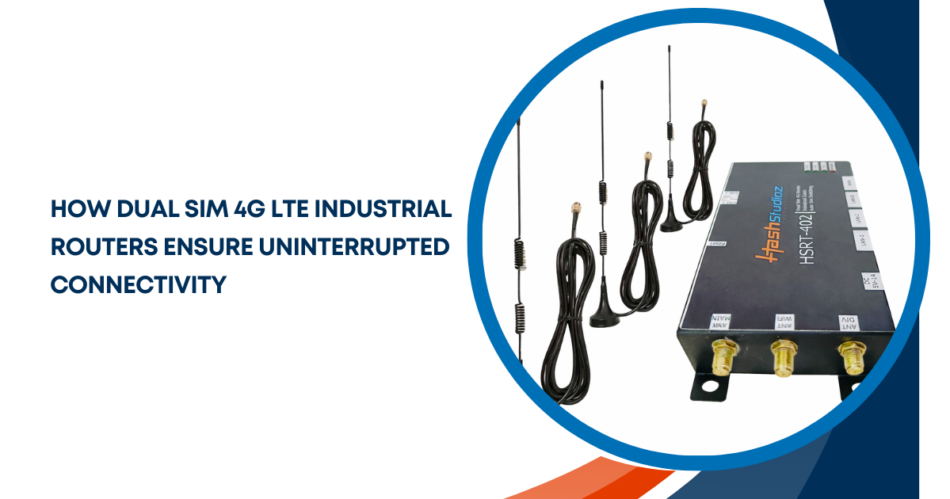
Reliable connectivity is critical in industrial networks. According to GSMA Intelligence, global cellular IoT connections surpassed 4 billion in 2024, representing roughly 22% of total IoT connections worldwide, with continued growth expected through 2030. The global industrial routers market is projected to grow at a CAGR of around 8.6 – 9.3% through 2032, driven by increasing demand for reliable industrial connectivity.
Single-network dependence creates risk. Network congestion, tower faults, or carrier outages happen more often than expected. Dual SIM 4G LTE industrial routers address this issue by providing redundancy at the network level. They allow systems to stay online even when one cellular link fails.
Why Uninterrupted Connectivity Matters
Industrial systems depend on constant data exchange. Machines send status data. Control systems send commands. Monitoring platforms expect steady input.
When connectivity drops:
- Remote monitoring stops – Systems can no longer send live status or performance data to control centers.
- Alerts fail to reach operators – Faults and critical events may go unnoticed until manual checks occur.
- Automation systems may pause – Control processes can halt or switch to safe modes due to lost communication.
In sectors like energy, transport, and manufacturing, downtime has a direct cost. Cellular redundancy reduces this risk by removing single points of failure.
What Is a Dual SIM 4G LTE Industrial Router
A dual SIM industrial router is a cellular networking device built for harsh environments. It supports two SIM cards, often from different carriers.
Unlike consumer routers, it is designed for:
- Continuous operation
- Wide temperature ranges
- Electrical noise and vibration
The router connects industrial devices to the internet using LTE networks. It switches networks when needed without manual action.
How Dual SIM Functionality Works
1. Primary and Secondary SIM Roles
Most routers assign one SIM as primary. The second acts as backup. The router monitors connection quality in real time.
If the primary link degrades or drops, the router switches to the secondary SIM.
2. Automatic Failover Logic
Failover decisions rely on parameters such as:
- Signal strength
- Packet loss
- Latency
- Network registration status
Switching happens in seconds. Applications continue running without restart.
3. Carrier Independence
Using SIMs from different carriers improves coverage. If one provider faces a regional outage, the other often remains active. This approach reduces dependence on a single telecom network.
Load Balancing in Advanced Models
Some industrial routers support traffic distribution across both SIMs. This helps when:
- Bandwidth demand increases – Network load is shared to maintain stable performance.
- One link becomes congested – Traffic shifts to the other SIM to reduce delays and packet loss.
Critical data can stay on the stable link. Less critical traffic uses the secondary network.
Hardware Design for Industrial Use
1. Rugged Construction
Industrial routers use metal enclosures and reinforced connectors. They handle vibration, dust, and heat better than consumer devices.
Many models operate between -40°C and +75°C.
2. Stable Power Handling
Wide input voltage support protects routers from power fluctuations. This matters in substations and mobile installations.
3. Antenna Support
External LTE antennas improve signal quality. Some routers support dual antennas for diversity reception.
Network Protocol Support
Industrial environments often run mixed systems, so routers must handle both older and newer communication methods. To support this, industrial routers commonly work with:
- TCP/IP – The basic networking protocol used for standard data communication.
- Modbus TCP – A widely used industrial protocol for exchanging data with PLCs and controllers.
- MQTT – A lightweight messaging protocol designed for reliable data transfer in IoT systems.
- OPC UA – A secure industrial standard used for structured data exchange between machines and software systems.
This allows direct integration with PLCs, sensors, and SCADA systems.
Security Features That Protect Connectivity
Cellular networks are public by nature. Security must be handled at the router level.
1. Encrypted Tunnels
Most industrial routers support VPNs such as:
- IPsec
- OpenVPN
- WireGuard
These protect data during transmission.
2. Firewall and Access Control
Built-in firewalls limit inbound and outbound traffic. Access rules reduce exposure to attacks.
3. Secure Remote Management
Administrators manage routers through secure web interfaces or cloud platforms. This avoids unsafe open ports.
Remote Monitoring and Control
Dual SIM routers often include monitoring tools.
Operators can:
- Check signal quality
- Track data usage
- View active SIM status
Alerts notify teams when a link fails or switches. This reduces response time.
Common Industrial Applications
1. Energy and Utilities
Solar plants and wind farms often sit in remote areas. Wired networks are unavailable. Dual SIM routers maintain telemetry and control links even during carrier outages.
2. Transportation Systems
Fleet vehicles move across regions with varying coverage. One network rarely covers all routes. Dual SIM routers switch networks as vehicles move.
3. Manufacturing Facilities
Factories depend on real-time data. A network drop can halt production lines. Cellular redundancy protects operations during local ISP failures.
4. Remote Monitoring Sites
Water treatment stations, pipelines, and mining sites rely on cellular access. Dual SIM routers keep data flowing without on-site intervention.
Real-World Impact on Uptime
Field deployments show clear results. Industry data suggests dual SIM setups reduce downtime by 70–85% compared to single SIM systems.
Failover times often stay below five seconds. Most applications continue without noticing the switch.
Operators report fewer site visits and lower support costs.
Deployment Best Practices
Following deployment best practices ensures that dual SIM 4G LTE industrial routers operate reliably and efficiently. Careful planning, correct configuration, and regular monitoring help maintain continuous connectivity, reduce downtime, and protect critical industrial systems.
1. Choose Carriers Carefully: Select carriers with strong local coverage. Avoid relying on two SIMs from the same provider group.
2. Configure Failover Thresholds: Set clear limits for signal and latency. This prevents constant switching between networks.
3. Monitor Data Consumption: Failover SIMs still consume data. Track usage to avoid service suspension.
4. Secure the Configuration: Disable unused services. Keep firmware updated. Use strong authentication.
Single SIM vs Dual SIM Comparison
- Single SIM routers depend on one network
- Dual SIM routers provide redundancy
- Single SIM setups fail during outages
- Dual SIM systems recover automatically
For critical systems, the difference affects reliability and cost.
Future Outlook
LTE remains widely available across regions. Many industrial sites lack full 5G coverage.
Dual SIM 4G LTE routers will remain relevant for years. Some models already support hybrid LTE and 5G modules.
Redundancy will continue to matter more than raw speed.
Conclusion
Dual SIM 4G LTE industrial routers solve a real problem. They protect systems from network instability and carrier failures. By combining failover logic, rugged hardware, and secure networking, they keep industrial operations connected.
For applications where uptime matters, dual SIM connectivity is no longer optional. It is part of basic network design.


