 WhatsApp Us Now
Market Overview and Growth Outlook
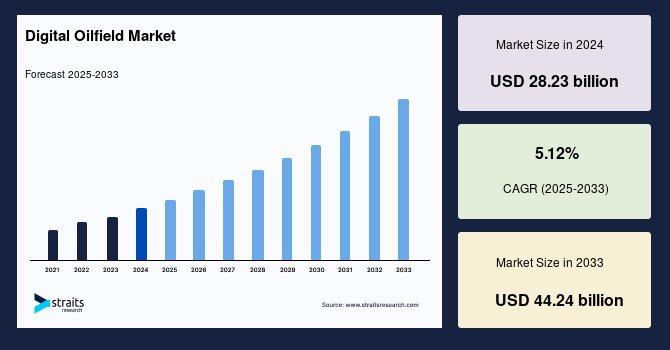
The global digital oilfield market size was valued at USD 28.23 billion in 2024 and is estimated to grow from USD 29.67 billion in 2025 to reach USD 44.24 billion by 2033, growing at a CAGR of 5.12% during the forecast period (2025–2033).
Key Technologies Driving the Market
Digital oilfield solutions leverage advanced sensors, automation systems, and data analytics platforms that enhance productivity and safety. For instance, IoT devices gather real-time data from equipment and field operations, enabling operators to monitor conditions remotely and predict equipment failures before they occur. AI algorithms analyze vast datasets to optimize resource extraction and reservoir management, while cloud computing offers scalable data integration and collaborative capabilities across diverse geographic locations.
Market Drivers and Challenges
The digital oilfield market is primarily driven by the urgent need to lower operational costs and increase efficiency. Aging oilfield infrastructure poses a challenge, but digital technologies help extend equipment lifespan through predictive maintenance and continuous performance monitoring. Additionally, the global surge in energy demand, particularly in developing economies experiencing rapid urbanization and industrialization, further fuels the adoption of digital oilfield solutions.
However, some significant restraints remain. The initial capital investment for deploying complex digital systems is substantial, making it difficult for smaller firms to adopt these technologies. Costs associated with technology integration, employee training, and maintaining cybersecurity also add to the financial burden. Moreover, resistance to change within traditionally conservative segments of the oil and gas industry can slow down technology uptake.
Regional Market Insights
North America leads the market with its mature oil and gas infrastructure and strong emphasis on automation and real-time monitoring. The region benefits from advanced technological readiness and substantial investments aimed at enhancing operational efficiency and reducing environmental impact.
The Asia-Pacific region, meanwhile, is witnessing rapid market growth supported by increasing energy demand and industrial investments. Countries like India and China are expanding their exploration and production activities, adopting digital solutions to manage complex oilfield operations more effectively.
Europe’s growth is influenced by stringent environmental regulations and a strong focus on sustainability. Here, digital technologies are pivotal in managing the transition to hybrid energy sources and reducing the carbon footprint of oil production.
Market Segmentation
Among the various applications, production optimization holds a dominant market share due to its immediate impact on output enhancement and cost savings. Digital tools enable real-time control and predictive analytics, directly improving oil recovery rates while minimizing equipment downtime.
In terms of solutions, hardware remains the largest segment because sensors, control systems, and distributed control systems form the backbone of digital oilfield technology. The cloud-based segment is gaining traction for its flexibility, cost-effectiveness, and ability to support AI and machine learning functionalities.
Onshore oilfield operations represent the largest deployment mode, favored for their accessibility and lower complexity compared to offshore fields. Onshore fields benefit from faster digital adoption due to reduced infrastructure costs and lower implementation risks.
Industry Trends and Strategic Initiatives
Companies in the digital oilfield market are actively investing in expanding their technology portfolios, emphasizing AI, IoT, and cloud computing. Strategic collaborations, mergers, and acquisitions are common to offer integrated, end-to-end solutions that cover upstream, midstream, and downstream operations.
There is also a growing trend towards digital transformation supported by government initiatives, which provide investments and policy incentives to accelerate technology adoption. These measures are crucial in fostering innovation and overcoming cost and resistance barriers.
Future Outlook
The digital oilfield market is set for robust growth given the increasing demand for smarter, safer, and more sustainable oil and gas extraction methods. As digital technologies become more scalable and cost-efficient, adoption across the industry is expected to accelerate worldwide. Long-term returns on investment, combined with the rising pressure to improve productivity and environmental performance, will drive more companies to embrace these digital solutions.
The increasing exploration activities in emerging markets, along with the expanding capabilities of AI and IoT, promise to reshape traditional oilfield operations into highly efficient, data-driven ecosystems, revolutionizing the energy sector’s future.


