 WhatsApp Us Now
Types of Diamonds: A Complete Guide for Everyone
Introduction
Diamonds have always been called forever stones, symbolizing love, elegance, and status. But did you know that not all diamonds are the same? From their natural origins to how they are cut and polished, diamonds come in many fascinating varieties. Whether you’re shopping for jewellery, planning an engagement ring, or simply curious, understanding the different types of diamonds can help you appreciate their uniqueness even more.
In this article, we’ll take a deep dive into the types of diamonds, the types of diamond cuts, and how they play a role in jewellery design. Think of it like walking into a treasure chest full of sparkling gems—each one has its own personality and charm.
Discover different types of diamonds, types of diamond cuts, and jewellery design ideas. Learn about the beauty and uniqueness of diamonds in detail.
What Makes Diamonds So Special?
Diamonds are more than just pretty stones—they’re the hardest natural material on Earth. Their sparkle, or “fire,” comes from the way they reflect light. This combination of rarity, durability, and brilliance makes them the ultimate choice for jewellery design.
Imagine holding sunlight in your hand—that’s what a diamond feels like. Its shine comes alive with every movement.
Natural Diamonds vs. Lab-Grown Diamonds
- Natural Diamonds: Formed over billions of years deep inside the Earth. Each is unique and rare.
- Lab-Grown Diamonds: Created in laboratories with advanced technology. They look identical to natural diamonds but cost less.
Both are real diamonds. The difference lies only in how they are formed. If budget matters, lab-grown diamonds can be a smart choice without compromising on beauty.
Types of Diamonds by Formation
Diamonds are formed in different ways, leading to distinct categories:
- Kimberlite Diamonds: Found in volcanic rock, these are the most common source of natural diamonds.
- Alluvial Diamonds: Found in riverbeds and coastal areas, carried by natural forces.
- Synthetic Diamonds: Created using processes like HPHT (High Pressure High Temperature) or CVD (Chemical Vapor Deposition).
Each type tells a story of its journey from the Earth’s core to your jewellery box.
Different Types of Diamonds by Color
Not all diamonds are white or clear. In fact, they come in a rainbow of shades:
- White Diamonds: The classic, most desired diamonds.
- Yellow Diamonds: Caused by nitrogen presence.
- Blue Diamonds: Rare, with traces of boron.
- Pink & Red Diamonds: Extremely rare and expensive.
- Green Diamonds: Colored by natural radiation exposure.
- Black Diamonds: Unique, dramatic, and often used in bold jewellery designs.
Colored diamonds are like nature’s artwork—each hue adds a new layer of beauty.
Types of Diamonds by Clarity
Diamond clarity refers to how flawless a stone is. Common categories include:
- Flawless (FL): No visible imperfections.
- Internally Flawless (IF): Slight surface marks, no internal flaws.
- Very Slightly Included (VS1/VS2): Tiny flaws not visible to the naked eye.
- Slightly Included (SI1/SI2): Small imperfections, often affordable choices.
- Included (I1/I2/I3): Visible flaws, less valuable.
Think of clarity like a window—the cleaner it is, the more light can shine through.
Famous Types of Diamonds in History
Some diamonds have made history:
- The Hope Diamond: A stunning blue diamond with legends of mystery.
- Koh-i-Noor: One of the largest diamonds, part of the British Crown Jewels.
- Cullinan Diamond: The largest rough diamond ever found, cut into many famous stones.
These gems are not just stones—they’re storytellers of empires and legends.
Understanding Types of Diamond Cuts
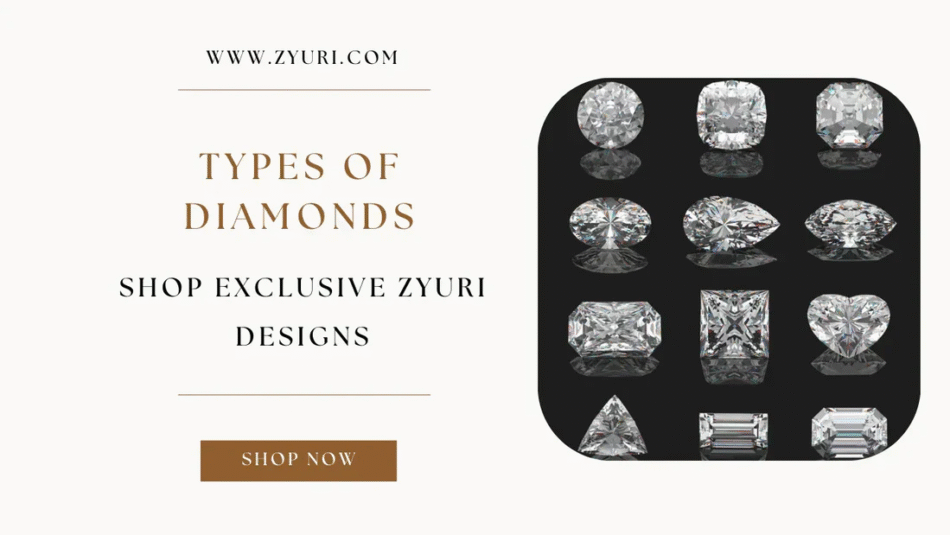
A diamond’s cut determines how much it sparkles. It’s not about shape alone but how well light bounces inside. Cuts are graded as:
- Excellent: Maximum brilliance.
- Very Good: Strong sparkle.
- Good: Decent shine.
- Fair & Poor: Less brilliance.
Think of it like trimming a crystal—done right, it shines like the sun.
Popular Diamond Cuts in Jewellery Design
Here are some well-known types of diamond cuts:
- Round Brilliant Cut: The most popular, maximizing sparkle.
- Princess Cut: Square-shaped, modern and chic.
- Emerald Cut: Rectangular, elegant, and sophisticated.
- Cushion Cut: Rounded square, vintage charm.
- Oval Cut: Elongated brilliance, makes fingers look slender.
- Marquise Cut: Boat-shaped, dramatic appeal.
- Pear Cut: Teardrop shape, graceful and unique.
- Heart Cut: Romantic and symbolic.
Each cut has a personality—just like people!
Rare and Unique Diamond Cuts
Apart from classics, some unique cuts stand out:
- Asscher Cut: Step-cut, vintage royalty look.
- Radiant Cut: Combines round brilliance with emerald style.
- Trillion Cut: Triangular, bold and modern.
- Rose Cut: Antique, soft sparkle.
These are perfect for those who want jewellery that feels one-of-a-kind.
Types of Diamonds in Engagement Rings
Engagement rings are the most popular diamond jewellery. Common choices include:
- Round Brilliant: Timeless love.
- Princess Cut: Modern romance.
- Cushion Cut: Vintage-inspired.
- Oval Cut: Trendy yet elegant.
The cut you choose often reflects your personality—classic, modern, or bold.
Diamonds in Fashion Jewellery
Beyond engagement rings, diamonds shine in fashion jewellery:
- Diamond Earrings: Studs, hoops, and danglers.
- Diamond Necklaces: From simple pendants to elaborate designs.
- Diamond Bracelets: Tennis bracelets remain iconic.
- Diamond Rings: Statement rings with colorful stones.
Fashion jewellery often mixes different types of diamonds with other gemstones.
The Role of Diamonds in Cultural Jewellery Design
Different cultures use diamonds uniquely:
- Indian Jewellery: Rich in tradition, often with uncut diamonds (Polki).
- Western Jewellery: Focus on diamond solitaires for engagements.
- Middle Eastern Jewellery: Heavy use of diamond-encrusted gold designs.
Diamonds reflect traditions, values, and status across societies.
How to Choose the Right Type of Diamond
When buying, keep the 4 Cs in mind:
- Cut: For sparkle.
- Color: White or fancy shades.
- Clarity: Fewer flaws means more brilliance.
- Carat: Size and weight.
Your choice should balance beauty, budget, and personality.
Myths vs. Facts About Types of Diamonds
- Myth: Bigger diamonds always sparkle more.
- Fact: Cut matters more than size.
- Fact: Cut matters more than size.
- Myth: All diamonds are clear.
- Fact: Diamonds exist in many colors.
- Fact: Diamonds exist in many colors.
- Myth: Lab diamonds are fake.
- Fact: They are real diamonds, just grown differently.
- Fact: They are real diamonds, just grown differently.
Knowledge helps you make smarter jewellery choices.
Future Trends in Diamond Jewellery
- Lab-Grown Diamonds: Gaining popularity for affordability.
- Sustainable Jewellery: Eco-friendly sourcing is in demand.
- Customized Cuts: Personalization is the future.
- Mix of Diamonds and Colored Gems: Fashion-forward designs.
Diamonds are evolving, but their charm will always remain timeless.
Conclusion
Diamonds are truly the gems of eternity—each type has its own beauty, whether it’s the fiery brilliance of a round cut, the uniqueness of a colored stone, or the symbolism behind an engagement ring. By understanding the different types of diamonds, types of diamond cuts, and their role in jewellery design, you can make smarter choices and enjoy their sparkle even more.
So, the next time you admire a diamond, remember—it’s not just a stone, it’s a story billions of years in the making.
FAQs
1. What are the most popular types of diamonds for engagement rings?
Round brilliant, princess cut, cushion cut, and oval cut diamonds are the most popular for engagement rings.
2. Are lab-grown diamonds considered real diamonds?
Yes, lab-grown diamonds are chemically identical to natural diamonds. The only difference is their origin.
3. Which type of diamond cut sparkles the most?
The round brilliant cut is designed to maximize sparkle and brilliance.
4. What is the rarest diamond color?
Red diamonds are considered the rarest and most expensive colored diamonds.
5. How do I choose the right diamond for jewellery design?
Consider the 4 Cs—cut, color, clarity, and carat—while balancing your budget and personal style.

