 WhatsApp Us Now
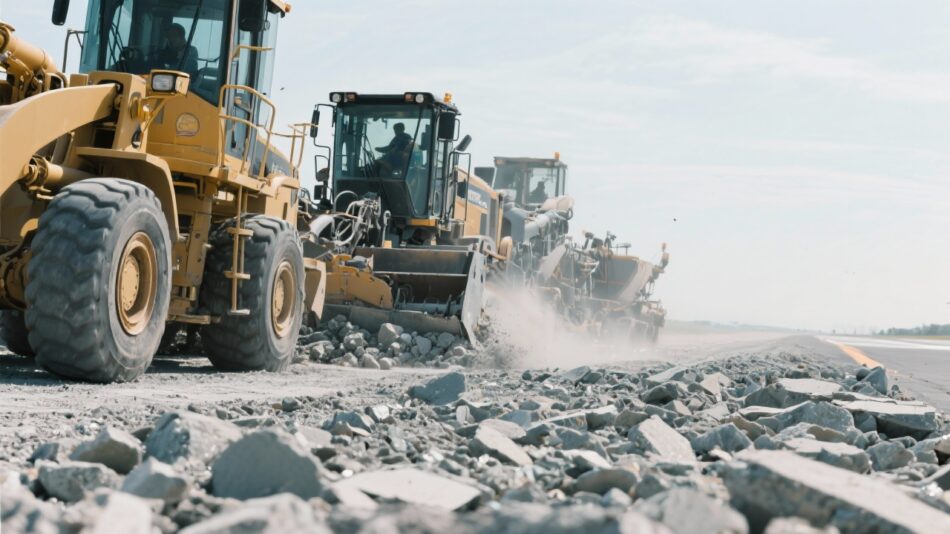
Airport runways are some of the most demanding pieces of infrastructure in the world. Every day, they withstand the impact of massive aircraft, extreme weather conditions, and constant wear and tear. To ensure safety and durability, runways require high-quality aggregates — and that’s where rock crushers play a vital role. By producing consistent, durable, and properly graded stone, these machines supply the foundation materials that keep aircraft operations safe and reliable.
Why Runway Construction Requires Superior Materials
Unlike regular roads or highways, airport runways must handle concentrated loads from aircraft weighing hundreds of tons. Each landing exerts tremendous force on the pavement.
This means the airport runway foundation materials must be:
- Strong enough to distribute loads evenly.
- Durable against freeze-thaw cycles, oil spills, and heavy traffic.
- Uniform in size and shape to ensure proper compaction and stability.
- High quality to meet strict aviation engineering standards.
Any weakness in the foundation can lead to cracks, rutting, or even catastrophic failure. High-quality aggregates from rock crusher quality aggregates are, therefore, non-negotiable.
The Role of Rock Crushers in Producing Runway Aggregates
Rock crushers in airport construction transform raw stone, recycled concrete, or asphalt into crushed aggregates that meet specific size and durability requirements.
Different types of crushers are used for various stages:
- Jaw crushers – for primary crushing of large rocks and concrete.
- Cone crushers – for creating uniform, high-quality aggregates.
- Impact crushers – ideal for recycling asphalt and concrete from old pavements.
- Portable crushers – enable on-site processing, reducing transport costs.
By using the right combination, contractors can ensure a steady supply of crushed stone for runways that meets project specifications.
Airport Runway Foundation Layers
Runway construction is a multi-layer process. Each layer depends on precise aggregate quality:
- Subgrade Preparation
The natural soil must be leveled and stabilized. Sometimes weaker soils are replaced or reinforced with crushed stone to improve strength. - Sub-Base Layer
A thick layer of compacted aggregate provides stability and distributes aircraft loads. This is often made of crushed stone supplied by crushers. - Base Course
A finer layer of high-quality aggregates ensures smooth compaction and supports the asphalt or concrete surface. - Surface Layer
Typically made of asphalt or Portland cement concrete, this layer must adhere tightly to the base, which requires a strong, stable aggregate foundation.
Every step relies on runway construction aggregate supply that is uniform, durable, and free of contaminants.
Reducing Transport Costs with On-Site Crushing
Airport projects often cover vast areas and require enormous volumes of aggregate. Transporting this material from quarries miles away can inflate costs and delay schedules.
Using portable rock crushers on-site delivers major advantages:
- Cuts hauling expenses – fewer trucks needed for transport.
- Speeds up project timelines – material is available immediately.
- Recycles demolition waste – old pavement and structures can be crushed and reused.
- Supports sustainability goals – reduces carbon emissions from transport.
For airport expansions or refurbishments, this efficiency is critical.
Why Quality Aggregates Matter for Safety
In aviation, quality is not optional — it’s mandatory. Cracks or weak points in a runway can cause foreign object debris (FOD), leading to tire blowouts, damaged engines, or accidents.
High-quality aggregates from rock crusher quality aggregates ensure:
- Load-bearing strength – runways can handle repeated heavy aircraft landings.
- Durability – resistance to weather extremes and chemical spills.
- Consistency – uniform size prevents uneven compaction or water infiltration.
- Longevity – reduces the need for costly repairs and closures.
Poor-quality stone can lead to premature failure, jeopardizing safety and disrupting flight operations.
Meeting Engineering Standards
Aviation authorities enforce strict standards for runway construction. Aggregates must meet tests for:
- Gradation – particle size distribution.
- Los Angeles abrasion resistance – ability to withstand wear.
- Soundness – resistance to freeze-thaw cycles.
- Cleanliness – free of clay, silt, and organic matter.
Modern rock crushers in airport construction are calibrated to produce aggregates that consistently pass these tests. Contractors often conduct lab testing to verify compliance before laying each layer.
Environmental Benefits of Using Rock Crushers
Sustainability is increasingly important in infrastructure projects, including airports. By integrating crushers into the supply chain, projects can:
- Recycle concrete and asphalt from old runways into new base layers.
- Reduce quarrying of virgin stone, conserving natural resources.
- Cut emissions by lowering transport requirements.
- Support green certifications that highlight eco-friendly practices.
This aligns with global trends toward environmentally responsible construction.
Case Study: Runway Expansion with On-Site Crushing
A major airport expansion required over 500,000 tons of aggregate. Traditionally, this would have meant months of hauling material from quarries 30 miles away. Instead, contractors brought in portable rock crushers to process existing rock and recycled concrete on-site.
Results:
- Cost savings of nearly 20% in material expenses.
- Timeline shortened by three months due to immediate aggregate availability.
- Environmental impact reduced by cutting thousands of truck trips.
This case demonstrates how on-site crushing improves both efficiency and sustainability.
Future of Rock Crushers in Aviation Infrastructure
As air traffic grows, airports worldwide will continue to expand and modernize. The role of rock crushers in airport construction will only become more important.
Future innovations may include:
- Hybrid and electric crushers – cutting fuel use and emissions.
- Smart automation – adjusting crusher settings in real time for optimal output.
- Advanced recycling – integrating new methods to reuse more runway materials.
- Carbon-neutral operations – aligning aggregate production with climate goals.
These advancements will ensure that runway construction aggregate supply remains both cost-effective and sustainable.
Conclusion
Airport runways demand the highest levels of quality, safety, and durability. At the core of every successful project is the production of high-quality aggregates — and rock crushers make this possible. By supplying crushed stone for runways that meets strict engineering standards, crushers ensure stable foundations, long-lasting surfaces, and safer flight operations.
With the added benefits of reduced transport costs, recycling capabilities, and environmental advantages, crushers are indispensable in modern aviation infrastructure. As air travel continues to expand, the importance of rock crusher quality aggregates in building strong, resilient runways will only grow.
In short, why quality matters is simple: because in aviation, there is no margin for error — and strong foundations built with the right aggregates keep the skies safe.


