 WhatsApp Us Now

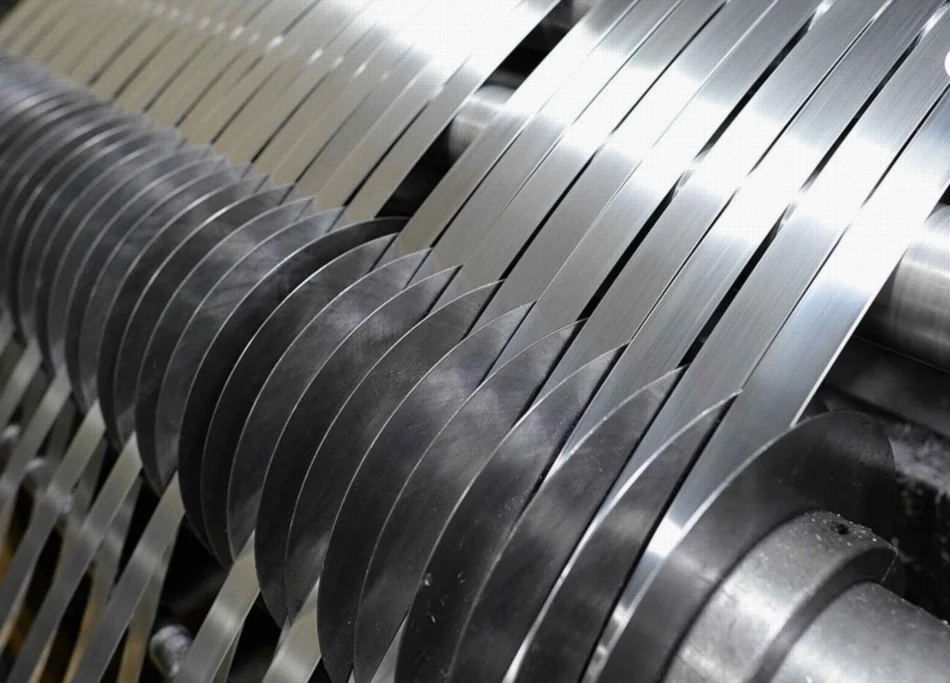
Narrow, flat, and rolled to tight gauge limits, a stainless steel strip hands the fabricator a starting material whose dimensions stay predictable from the first blank to the ten-thousandth. That predictability drives everything downstream. Stamping presses, press brakes, roll formers, slitting lines, and precision cutting equipment all depend on incoming stock that does not wander in thickness or temper, because every variation transfers straight into the finished component. Industries working to tight dimensional limits, visible surface standards, or chemical exposure treat strip selection as a design decision.
What Is a Stainless Steel Strip?
An SS strip begins as a wide stainless coil, cold rolled down to gauge, then slit lengthwise into narrower coils of a specified width. Annealing, pickling, skin passing, and edge conditioning follow, depending on the temper and finish ordered. Thickness commonly runs from 0.05 mm foil gauge up to around 3 mm, with widths from a few millimetres to 600 mm. Mills supply in coil, pancake coil, traverse wound form, or cut lengths. Finishes cover 2B mill finish, BA bright annealed, No. 4 satin, and mirror polish. Grade and dimension together decide behaviour at the tooling: a Stainless Steel Metal Strip in 301 full hard springs back sharply on a bend, while 304 in annealed temper draws deeply without cracking. Edge condition counts as well, since slit, deburred, and rolled edges each feed differently through a progressive die.
Key Properties of Stainless Steel Strips
- Dimensional consistency: Thickness held within a few microns across the full coil keeps cutting, stamping, and forming results repeatable from first blank to last.
- Strength and durability: Tensile values climbing from 515 MPa annealed to beyond 1300 MPa full hard let components carry the mechanical loads their design demands.
- Corrosion resistance: Corrosion-resistant stainless steel strips carry 16 to 18 percent chromium, forming a passive oxide film that shields parts in suitable service environments.
- Formability: Annealed 304 and 316 bend, draw, and shape without fracture, while harder tempers restrict forming to gentler radii and shallower draws.
- Surface finish: 2B, BA, and No. 4 options cover functional sealing faces, hygienic wipe-down surfaces, and visible decorative trims on finished assemblies.
- Weldability: Low carbon grades such as 304L resist sensitisation, so thin strip joins cleanly by resistance, TIG, or laser welding methods.
How Stainless Steel Strip Supports Precision Metal Fabrication
Accuracy on a press starts with gauge control. Strip held inside a tight thickness band keeps punch penetration, die clearance, and burr height steady, so the hundredth part measures like the first. Grade and temper govern the bend: springback in 301 half hard differs sharply from annealed 304, and matching temper to bend radius stops cracking at the outer fibre. Roll forming leans on width and camber, since a strip that wanders sideways throws the profile out of square along the entire length. Slitting to near net width removes secondary trimming and lifts yield per tonne. Consistent chemistry and mechanical properties across heats hold tolerances steady through long runs, which cuts scrap and rework. Tooling condition, press settings, lubrication, and inspection discipline still decide the final result.
Applications of Stainless Steel Strips in Precision Fabrication
- Automotive brackets, exhaust clamps, and retaining clips formed from 301 and 304 strip in quarter hard to full hard tempers.
- Electrical enclosure panels and connector contacts, where flatness and consistent gauge govern both fit and contact pressure.
- Industrial springs, spring clips, and circlips stamped from full hard 301, which work hardens further during the forming stroke.
- Appliance fascias, drum components, and sheet metal housings that need a uniform BA or No. 4 surface.
- Medical trays, surgical instrument parts, and laboratory fittings produced from 316L for repeated sterilisation cycles.
- Architectural trims, lift panel edging, and signage borders cut from polished strip carrying protective film.
- Filter mesh frames, machine shims, and gasket blanks slit to precise widths within 0.02 mm.
Grade, thickness, temper, and finish should all match the intended application rather than the nearest stocked size.
Choosing the Right Stainless Steel Strip for Fabrication
Grade 301 work hardens quickly and suits springs and clips; 304 covers general fabrication, and 316 adds 2 to 3 percent molybdenum for chloride exposure. Match thickness and width to the blank layout instead of buying wide and trimming later. Specify annealed for deep draws, quarter to full hard where resistance to springback is important. The temper determines whether the part will be easy to form or will retain its shape under load. Select finish by function: 2B for general work, BA for reflectivity, No. 4 for hygienic equipment. Specify thickness, width, flatness, camber and edge tolerances on purchase order. Confirm the mill test certificate names the heat number, chemistry, and mechanical results against ASTM A240 or A666 as applicable.
Quality Control in Stainless Steel Strip Fabrication
Verification belongs at goods inward. Read the mill certificate against the grade ordered, then confirm chemistry with a portable XRF shot taken on the coil itself. Micrometer readings at several points across the width and along the length catch gauge drift, with width, flatness, and edge condition checked alongside. Inspect the surface under strong light for scratches, roll marks, and dents that will show through after forming. Rockwell or Vickers testing confirms temper. First-off and periodic dimensional checks close the loop, and batch records tied to heat numbers keep traceability intact when a query lands months later.
Conclusion
Dimensional consistency, controlled temper, surface quality, and alloy chemistry together decide whether a precision part leaves the press inside tolerance. Specify grade, thickness, temper, and finish against the actual fabrication route rather than the nearest stock size, and the gains show up as accurate components, lower scrap, and steadier quality across every production batch.


