 WhatsApp Us Now

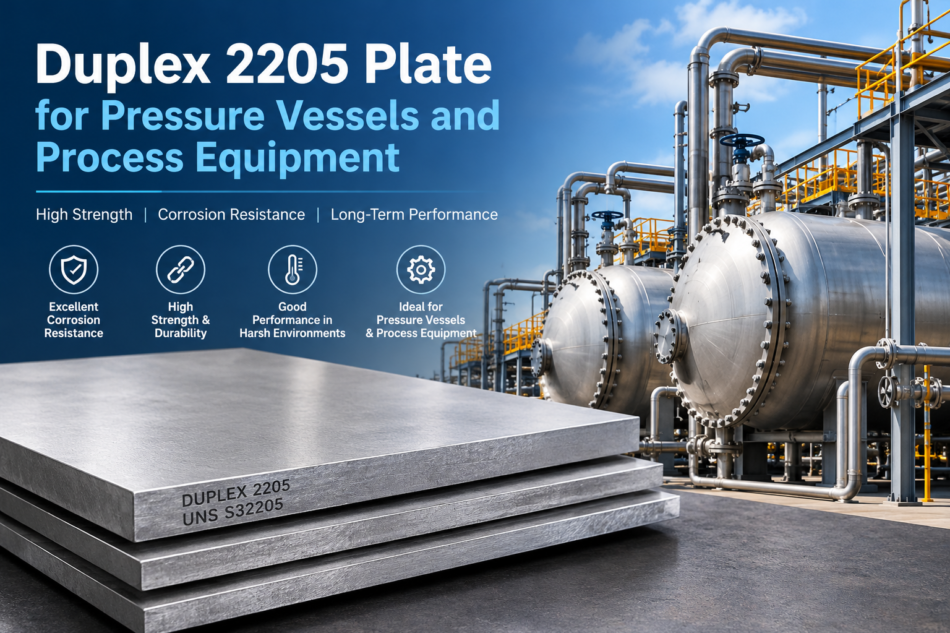
Duplex 2205 Plates provides roughly twice the minimum yield strength of 316L stainless steel, along with stronger resistance to chloride-induced corrosion and stress corrosion cracking. Pressure vessels and process equipment face corrosive fluids, mechanical loading and temperature swings at once, and a material answering only one of those fails on the others. Material selection carries real weight in chemical processing, oil and gas, petrochemicals, water treatment, and industrial manufacturing. This guide covers the properties, pressure vessel applications, advantages, limitations and selection considerations for Duplex 2205 plate.
What Is a Duplex 2205 Plate?
A Duplex 2205 Plate is a flat-rolled stainless steel product whose microstructure holds austenite and ferrite in roughly equal proportions. That dual structure is where the name duplex comes from, and it is the source of the grade’s properties. Grade 2205 contains 22 to 23 percent chromium, 4.5 to 6.5 percent nickel, and 3.0 to 3.5 percent molybdenum, with nitrogen from 0.14 to 0.20 percent. Nitrogen stabilizes austenite while raising strength and pitting resistance. Ferrite contributes strength and chloride stress corrosion cracking resistance; austenite contributes toughness.
ASTM A240 is the specification usually cited for stainless steel plate, sheet, and strip in pressure vessels and general applications, covering Duplex Stainless Steel Plate alongside austenitic grades. Thickness and dimensions follow the vessel design calculation and the fabricator’s forming capability.
Key Properties of Duplex 2205 Stainless Steel Plates
Explore the essential mechanical and corrosion-resistant features defining Duplex 2205 stainless steel plates below.
- High mechanical strength defines the grade. ASTM A240 sets minimum yield at 65 ksi and minimum tensile at 95 ksi for S32205, against 25 ksi and 70 ksi for 316L. That is more than double the yield.
- Corrosion resistance comes from chromium, molybdenum and nitrogen together, giving a PREN of around 35. Pitting, crevice corrosion and chloride-induced stress corrosion cracking all meet stronger resistance than conventional austenitic grades offer.
- Good toughness holds down below minus 40°F when the material is correctly processed and kept inside its temperature window.
- Pressure-bearing suitability follows from the strength, though allowable stresses still come from the governing design code rather than the datasheet.
- Weldability is achievable with qualified procedures. Heat input control matters, because the ferrite to austenite balance shifts if cooling runs too fast or too slow.
- Fabrication considerations follow from that strength. A 2205 Stainless Steel Plate needs more press force and more rigid machining setups than an austenitic Duplex Steel Plate alternative.
Applications of Duplex 2205 Plate in Pressure Vessels
Chemical Storage Vessels
Storage vessels holding corrosive chemicals and chloride-bearing solutions use 2205 where 316L would pit. Check concentration, temperature and exposure duration first, since a solution harmless when cold can turn aggressive at 60°C.
Pressure Vessels in Oil and Gas
Oil and gas processing facilities apply Duplex 2205 Steel Plate in selected pressure-containing equipment, where strength and corrosion resistance both matter. Suitability still depends on the process fluid, design pressure, temperature and the applicable code.
Reactors and Separators
Reactors, separators and vessel internals exposed to corrosive media draw on the same balance. Material compatibility and fabrication quality decide integrity, since a correct plate welded badly performs worse than a lesser grade welded well.
Role of Duplex 2205 Plates in Industrial Process Equipment
Heat Exchangers and Process Vessels
Plate-fabricated components carrying corrosive process fluids suit the grade, provided thermal conditions, pressure requirements and the actual corrosion mechanism are assessed rather than assumed.
Chemical Processing Equipment
Tanks, process vessels and fabricated equipment in chemical manufacturing benefit from resistance to localised corrosion, particularly where chlorides are present in the stream.
Desalination and Water Treatment
Saline and chloride-bearing water components are a natural fit. Check chloride concentration, temperature, flow velocity and shutdown cleaning chemicals, which often prove more aggressive than normal service.
Piping and Industrial Support Equipment
Associated process equipment and fabricated components use Corrosion Resistant Steel Plate where strength and corrosion resistance both apply. Grade selection follows the precise service environment and engineering specification.
Duplex 2205 Plate vs 316L Stainless Steel Plate
Strength
2205 carries roughly 2.5 times the minimum yield of 316L, at 65 ksi against 25 ksi. That can influence wall thickness, but any reduction must be proven by calculation against the governing code.
Corrosion Resistance
PREN values tell the story: around 35 for 2205 against roughly 24 for 316L. Pitting and crevice resistance both improve, and the ferrite phase adds chloride stress corrosion cracking resistance that austenitic grades lack.
Fabrication and Welding
Forming a Duplex Steel Plate demands more force and more springback allowance. Welding needs controlled heat input and qualified filler to hold the phase balance. 316L fabricates under well established, more forgiving practice.
Material Selection
316L suits many general-purpose applications at lower cost and easier fabrication. A 2205 Stainless Steel Plate earns its place when higher strength, chloride resistance or both are genuinely required.
Benefits of Using Duplex 2205 Plate for Pressure Equipment
The following are some of the benefits of Duplex 2205 Plate for Pressure Equipment
- High yield strength for demanding mechanical duty.
- Strong resistance to pitting and crevice corrosion in suitable environments.
- Better chloride stress corrosion cracking resistance than conventional austenitic grades.
- Scope for optimised thickness through code-compliant design calculation.
- Proven service in selected chemical processing and oil and gas applications.
- A balanced combination of strength and corrosion performance in one material.
- Lower maintenance and replacement demand when correctly specified.
Factors to Consider When Selecting Duplex 2205 Plates
Finally, the quality needs for long-term serviceability of process equipment and the conditions of chemical containment must be considered in making the final decision on the use of Duplex 2205 stainless steel plates.
- First, keep process temperatures below 600F (315C) to minimize microstructural embrittlement;
- Test chemical composition and chloride levels and pitting resistance of your process fluid
- Review UNS S31803 and UNS S32205 plate thickness, dimensional limits, and dual specifications.
- Define post fabrication NDT and heat input control and table welding processes
- Purchase from a qualified vendor and verify material documentation, heat number traceability, and mill test certificates
Common Mistakes When Selecting Duplex 2205 Plates
- Choosing the grade on general corrosion resistance without checking the specific medium.
- Ignoring process temperature and chloride concentration together.
- Assuming higher strength automatically permits thinner vessel walls.
- Overlooking pressure vessel code requirements.
- Using unsuitable welding procedures or filler metals.
- Failing to verify certification and heat traceability.
- Ignoring prolonged exposure to unsuitable temperature ranges.
- Neglecting inspection and quality control during fabrication.
Conclusion
Duplex 2205 plate combines high strength with strong corrosion resistance, making it suitable for selected pressure vessels and process equipment. Chemical processing, oil and gas, storage vessels, and water treatment can benefit from this balance when service conditions are suitable. Selection depends on design pressure, operating temperature, process chemistry, fabrication method, and applicable standards. Suppliers such as Bhansali Enterprises can support these requirements by offering specified Duplex 2205 plates with appropriate material documentation and traceability.


